
A study in Finland has found the first-ever evidence of complex thinking in insects by demonstrating that bees can solve problems without previous training, challenging the assumption that these abilities are restricted to humans and other animals with large brains.
Researchers at the University of Oulu challenged bees to roll a Styrofoam ball and use it as a stepping stone to reach an artificial flower with a sugar reward. None of the bees had been shown that the ball could serve to reach the flower. First, bees that had previously explored only the flower, the ball, or both, were placed in an arena with both objects. Only the bees that had explored both objects before could roll the ball to the right position, showing that they used prior experience to put the pieces together and solve the problem.
To confirm that they were acting deliberately, the team placed the bees in an arena where the flower and the ball were in compartments behind walls and the bees could not see the flower from the position of the ball or along the way. After exploring the location of the flower, 23 out of 30 bees succeeded on their first try, going back to the ball and moving it along the arena to the right spot using only their memory. The only factor that predicted success was how long the bees had previously explored the compartment with the flower.
“We are not claiming that bees think like humans, but our findings show that miniature brains can generate flexible solutions to novel problems in ways we are only beginning to understand,” said Olli Loukola, leader of the study published in Science.
This finding changes our understanding of animal cognition and could have implications for insect welfare and conservation.
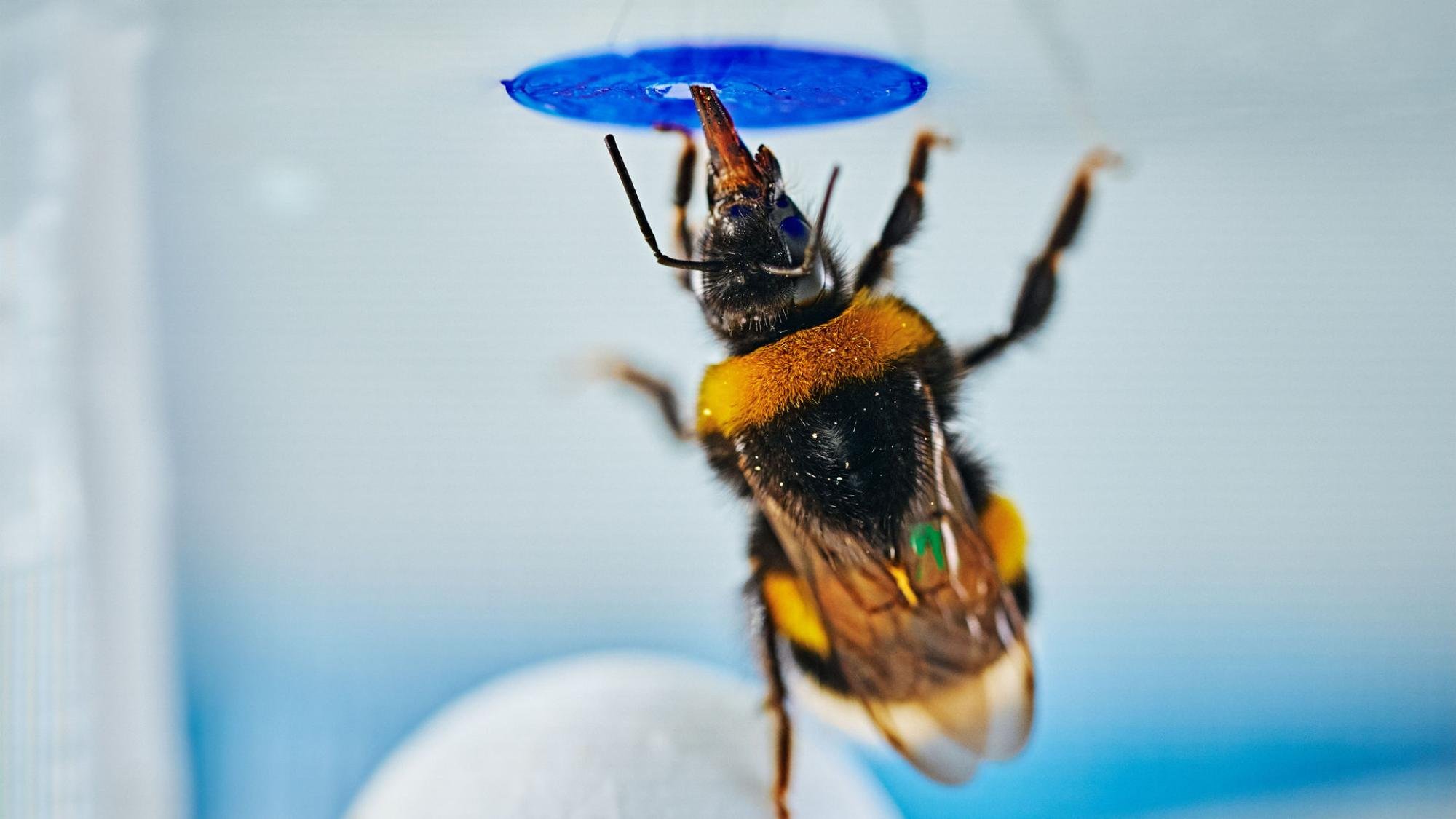
A bumble bee standing on a ball beneath the artificial flower containing reward. Credit: Mikko Törmänen / University of Oulu